Sunday, September 05, 2010


Comparing a Couple of Sites: Exercising


A number of years ago, I signed on to a site called Asimba. It was a site that allowed me to keep track of the various exercise programs I was doing. At that time it was running and biking. It was a very useful site, easy to use and easy to follow the progress. I even bought a hat and tee shirt. I still own both and wear both, the hat is what I still wear when I do go running. Shortly after purchasing the wear, the company was bought by another company and they screwed it up royally. What was easy became difficult. It became more of an advertisement. Since then, nothing was out there, at least nothing that was as simple and straightforward as I thought Asimba was to me. By the way, the motto of the site was: "Because Endorphins Feel Good". That's very true, by the way, nothing like exercise to enhance the daily mood. Nothing like the release of Endorphins to improve one's outlook as well.

What have I been using? Nothing. That is until recently.

It was about March I discovered the site Skimble. This is a very nice site. To sum up what it's all about, let me quote from the About Page:
Skimble is the ultimate companion for your active life. With the mission to inspire active lifestyles, Skimble provides a location-based, social iPhone and web application to help you plan, track and discover activities nearby and far. Use Skimble to connect with other active people and share your achievements with friends. Track all your sports activities, compete on the leaderboards and win prizes just for being active. Skimble will automatically remember your Personal Bests and help you monitor your progress over time. Whether you run, hike, bike, rock climb, ski, snowboard, kayak, canoe, do cardio, lift weights, or practice yoga and pilates, join the fun and skimble it!


You sign up, go through the list of exercises, and it's quite extensive, and begin to start keeping records. If it is an exercise, you can find it listed and you can start keeping your statistics on what you're doing. As this is the age of social networking, you can make friends and followers. This is important since you can compare yourself to those you follow. You can see what they are doing and you can also send notes to one another. On your main page, there is a leaderboard, so you can compare what you've done to others.

If you do a personal best on any of the exercise, you will get a notice, which will make you feel pretty good. As well, you can look back and discern whether or not you've approved since the last time. If you put in your Twitter and Facebook information, you can post to those sites at the same time. This is good if you've done a personal best. Just be aware, this will make you open to funny comments from the less, shall we save, active of your friends. At the same time it will garner comments of encouragement. You take the good with the bad.

It also keeps record of how you've done since joining the site. I think this is a good feature, if anything, you may be impressed with the numbers. I know I was impressed when I checked my own statistics.

There is also an app which can be installed on the iPhone and iPod Touch as well as Android devises. So you can keep track wherever you are as you exercise. The app also has GPS ability, which is good for the iPhone. Since I don't I don't use.

As a means of investing, you can Go Pro. For $24.95 a year, there is enhancements to assist with your workout. I haven't joined yet, I'm thinking about it.

There is also a Store, so you can buy your t shirt.

Also, there is a monthly contest and draw, the more you do, the more active you are, the getter your chance of winning that month's prize. I have yet to win.

They are a friendly bunch as well. One of the co-founders Maria Ly, will answer your emails and encourage you.

I have made this site known to a chair of a wellness committee. If exercise is a part of your lifestyle. This site is worth looking into and getting involved.


Another site worth looking into is DailyMile. The emphasis on this site is to be a social network of those who train. It's been referred to as the Twitter for Runners. I've just started using this site, so my thought are not as extensive. It is a pleasant site. Very neat and does the job well. You can map your route, it will calculate the miles, or kilometres ran, or biked or whatever method you use. There is also a Store, for the tee shirt.

As it is a social network as well, you can follow and be followed. From the following, you can get words of encouragement from other runners. You can set your goals, be it a race you're training for, or just the fact you want to enjoy a healthy lifestyle. Some of the nice things, you can send motivators and receive the same. As with both sites, you can add photographs, probably a good thing if you've got someone taking pictures as you finish a race. It's also a good site. What it has going for it that Skimble doesn't, is that it tracks in Kilometres. If there is one issue I have with Skimble is that everything has to be either entered as miles, which is true with the iPod Touch app or it will be translated into miles, if you add in kilometres, such as at the website. It's a minor quibble, but since I live in Canada, it's important. On the other hand, DailyMile has no app for iPhone or Touch.

Both sites are good. I would say Skimble is more extensive if you are active in a number of different activities, while DailyMile tends to concentrate on running. It mentions other activities, but I believe most people using will do so with running.

It comes down to personal preference. I can see myself using both, because it's good to keep a record. Now with the Fall Season coming, the temperatures will begin to fall, as well as the humidity, so you can still get out there and start exercising.

Saturday, September 04, 2010


Is the Web Dead?


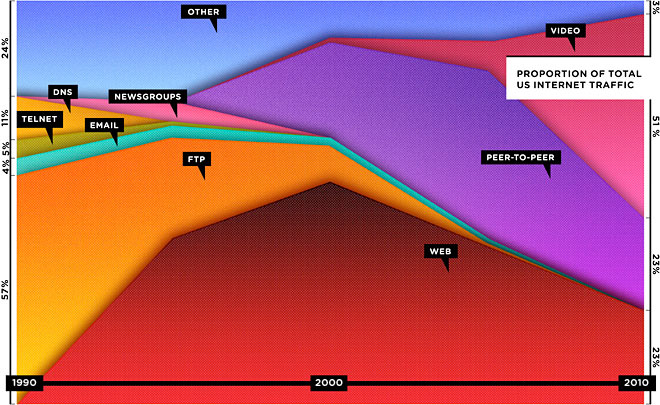
Much is being made of the recent article, in fact the lead article in the September issue of Wired Magazine. The front cover screams the news "The Web is Dead". The concept and major point of the article is that the Internet of the web browser is reaching its last legs. For the first few decades, at least since the invention of HTML, the Internet has been defined by the Web. We browsed it, which is why the way we see it is through browsers. I know there will be those who will roll their eyes at that statement.

It could be said that the criticism is unfair, that neither author, Chris Anderson or Michael Wolffe see the demise of the web as we know it. They don't. They do foresee a future when most of us will be going to an Internet of apps and the API.

An important piece of the explanation is the graph:


The graph demonstrates how things have changed, FTP is a thing of the past as is newsgroups. Email is on the way out, probably due to the overwhelming amount of spam that clogs all our mail folders. What we have is video, peer to peer and, what's this still the web. They almost defeat their own purpose.

What is driving this, to continue the article is things such as Facebook, which has become the destination all the time for all sorts of people. It almost seems that Facebook wants you to log on and stay, almost as AOL did back in the day.

One of the paragraphs state:
But the Web is a different matter. The marketplace has spoken: When it comes to the applications that run on top of the Net, people are starting to choose quality of service. We want TweetDeck to organize our Twitter feeds because it’s more convenient than the Twitter Web page. The Google Maps mobile app on our phone works better in the car than the Google Maps Web site on our laptop. And we’d rather lean back to read books with our Kindle or iPad app than lean forward to peer at our desktop browser.


I suppose this is the truth. The apps on the mobile devises or tablet PC's, of which the iPad is only the first, seem to want to make life very easy and very controlled. Also there's the whole matter of monetization. The Promised Land has always been that you can get rich on the web. History has proven you actually can't, well unless you're Google, or have such a great site and product that you're bought up by Google.

It is the apps that make the money, apparently. This is true if you get past the gatekeepers at Apple. If they believe in your app and it is placed in the iTune Store, there is a way to make a few dollars. I suppose a lot of media groups are taking advantage of this fact and making apps to sell that present their content to people who just want to read the news, or their email, or watch a few videos, or comment on Twitter.

It is convenience. We don't have the time, plus on mobile devises, the web is a bit difficult. When you're used to something like a 1920x 1440 and then try to view the same thing on a screen that could be a couple of inches in diagonal, it's easy to see why that would not be a nice experience.

There are those who question the ideas, in fact one of the most directed criticism has to do with the graph. The most excellent site Boing Boing suggests this should be the graph:


So instead of web using declining, it too is increasing. They ask the question in the article, "Is the Web really dead?". Part of their premise has to do with amounts, they ask:
It's also worth adding that bandwidth, though an interesting measure of the internet's growth, isn't so good for measuring consumption. It doesn't map to time spent, work done, money invested, wealth yielded... Does 50MB of YouTube kitteh represent more meaningful growth than a 5MB Wired feature? And, as others point out in the comments, many of the new trends are still reliant on the web to work, especially social networking.


Which has the most digits? Of course the video. An article, like a document is very sparse in using bits so in one way its unfair.

If it was just making money, then the premise would be correct, but if anything the Internet has proven to be a hard place to make money. Everyone tries to invent the Internet to suit their idea and image. There is a place for apps, it is growing and probably is thriving. Although I have heard that google apps is not the place to be if you want to make some money. Also, it can be said we want easy, simple and straightforward. Wny fire up the desktop or laptop, when the information we need is available on our phone or tablet- and it will take a lot less time.

The problem is that people have never done very well behind the garden walls; AOL did try to keep everybody in their place, but they lost out to the web. Even when they offered to give a limited access, people left in droves. There is nothing to say the walled garden will succeed this time. I think people like Facebook as a way to connect, but I don't think they see it as the be all and end all of the Internet. It is a good place to keep in touch with people, and it should be seen as that and perhaps nothing more. It's also a place to play games and can I be honest, I don't care about your farm. There I said it.

Another problem is that so many of our mobile devises are for consumption, not creation. If the web and Internet has demonstrated anything, we are a creative bunch and when given the tools we like to take a lot of photographs and videos and all sorts of thing. I realize most of it is probably not that good, but the sheer volume says a lot of it will be good as well. By the way, you can't use those devises to upload video to YouTube, for instance. You got to use the Web. Funny.

Again, we like convenience. But we are content providers not just consumers. To state we can re-enter that phase of life again is silly. We were consumers for almost all of the 20th century, but when the tools became available, we all became content providers. Anyone who ignores this fact is foolish. Apple risks a great deal by not putting either a USB or card reader into the iPad. It could be a great photo editing devise, but it won't unless there is a way to add photographs.

I heard this description of the difference between the two, the web and apps. The Apps is like the suburbs or at least like a gated community. You know what you are getting, it is neat, it is safe. You have this sense of protection. The web is like the inner city, or downtown core, yeah you have to be careful but there's some really interesting things going on and very interesting things to see.

Is the Web dead? No. Is the Internet changing, of course it is. Apps are part of the natural evolution. People will make money through apps, until the system kind of collapses under the weight of too many flashlight and farting apps.

There should be something else about gated communities. The guy at the gate is named Wally and he's just making a few cents above minimum wage. When he sees the angry mob with torches and pitchforks coming; he's opening the gates.

Sunday, August 29, 2010


The Garden: End of August


The first planting took place beginning of May and so with the summer season drawing nigh, I'm going to look back at the gardening experience 2010.

I'm going to start with the pluses of the past season:

1) Zucchini. I had, as you know from reading this blog, two kinds, One Ball and your basic zucchini. Both were plentiful, especially the former. I read that one person said, with tongue in cheek, zucchini could solve world hunger all by itself. This is certainly true, is there a more prolific plant then zucchini. Perhaps next "Leave Zucchini on your neighbour's porch", the zucchini growing world should gather all the excess and put them all on one, or two of those super oil tankers. They should said to the continent that is experiencing famine, sneak into harbour, say in the middle of the night, and drop it off on the docks. Then the ships should leave, with wharfs full of zucchini, plus recipes.

I've dug up a few plants, they had served their purpose plus I had a nasty outbreak of powdery mildew. It slowed the plants down but now they were dying. I gave away a lot of zucchini this year, plus it showed up in a number of dishes and desserts in our home.

2) Tomatoes. I decided to try a few different plants this year. Three to be precise, Early Girl, Roma and Lemon Boy. The latter two did very well, I've been harvesting the past few weeks. Those of you who have gardens know there is nothing sweeter then eating a tomato just picked from the vine.


3) Eggplant. A first in my garden. I grew the Little Fingers variety. Turned successful. I may try the regular size next year.


4) Pepper: One plant and the peppers are going to be hot!

5) Sunflowers. The Prado Red is marvellous.

Fails
1) Carrots. May have one, maybe two carrots. Must read up on what I need to add to the soil.

2) Sweet peas, a few plants, some pods, not as much as I had hoped.

What about the flowers?

The Celosia: I both planted seeds and transplanted small plants. All have done well, plus a few suddenly appeared in the garden. Must have been some seeds from last year. A surprise in the garden can be a delight.


The Zinnias: these seeds were given as a gift. Quite a flower. Lot of them are growing and enhancing the colours of the garden.


I imagine another month or so. I'm already beginning to plan next year's gardens. It will involved digging, adding compost, topsoil and planting more seeds. Plus moving a few plants around.

I'll keep you posted.

Thursday, August 26, 2010


I got myself an Apad (not iPad)


2010 may go down as the year of the tablet computer. With the launch of the Apple iPad, it certainly seems that the tablet is back into the mix of possible computers to purchase and own. But it seems this market will not be the exclusive domain of Apple's for too much longer. The news is filled with the announced launching or launches of tablets. From Dell, Verizon, LG and others, the tablets will be the next big thing come Christmas time.

However, there is no need to wait until Christmas, because the Android based Google tablet exists! Indeed it does. It probably couldn't be classified as an iPad Killer, because probably nothing is, but it is there. They are also, compared to the iPad, dirt cheap. So inexpensive are they, that PCWorld had an article about them, referring to them as iPad knock-offs.

Wired even had an article about the devises, calling them Counterfeits of the Real Thing. But as many pointed out, if the "real Thing", doesn't exist, how can they be counterfeits? A very good point.

After all this reading, I went to ebay and ordered one. Yes I decided to get on the tablet revolution. After a problem with customs and a few emails to the company, the devise arrived at the local post office on Wednesday, August 25th. I ordered in around the time of my birthday in July but there was a snag. I don't blame the company, because according to them it was sent back. Not sure why, one of those things I suppose. But it finally arrived.

Here is a professional video of the Apad:


It's specs are:
RAM Installed Size DDR 128MB
Display Diagonal Size 7" touch panel
Max Resolution 800X480
Display Technology TFT
Graphics Type Integrated Graphics
Input/ Output Connectors
Audio/Video Built in 1×0.5W speaker,1× Integrated mircrophone, earphone×1
Memory Card 1x SD card slot. a 2GB SD card is attached for the item.
Communications Wireless Connection WIFI
Wireless Protocol 802.11 a/b/g
Operating System Andriod 1.6
IM Software MSN, Skype
Browser Andriod Browser
Office Word To Go, Sheet To Go, Slideshow To Go, PDF To Go.
Media player PeacockVideo, Music Player
Mail Android Email,POP3/IMAP/SMTP
Audio MP3
Video MP4 for Andriod
Image Jpeg, Gif
Other Software Google Maps,Calendar, Contacts, and many free software for Andriod.
Battery Type Built in 7.4V 1600MAH Li-ion Battery
Battery / Run Time (up to) 2 Hours
Power Device Type AC Adapter
Voltage required 100/240V
Color White
Dimensions / W x D x H 207mm(L) x119mm(W) x12mm(H)


It comes with an AC adaptor, a USB cord and a bilingual manual, English and Chinese.


I have opened the parcel, I have pushed the 'On' button and got it going. I've used a number of times since so I think I can give a bit of a review. First of all, it is a pleasant looking devise. It's white, very neat and very minimal. It gives one a good exposure to Android. It's light size makes it good to carry around and also, it's good to have when a person doesn't want to fire up the laptop but just wants to read some email or doing a bit of web surfing.

It's got a few quirks: it is slow, the screen is can be a challenge to find the right level of sensitivity to open programs or even to scroll up and down. I, at first, wasn't impressed with the keyboard, but then I recalled my many struggles with the iPod Touch and its keyboard. When listening to music, there is a bit of distortion between songs.

What's good: the screen is quite bright and it does go from landscape to portrait fairly straight forward. Music played through a pair of headphones or headsets does sound good. Yes there may be a distortion problem between each song, but it works out. Viewing photographs is a good experience. There is a bit of a learning process, but that's typical with any new system. Browsing is also good. The built in browser handles all things well. With the email program, you can set up any email to go. When new email comes, a sound is made letting you know of the arrival.


It does the simple tasks, such as reading and writing email, surfing the web and also doing some instant messaging. I've sent messages to some social network sites without any problems.

I can say that the next step will be to get some android apps onto the devise and make it a bit more versatile.

The question is, how will I use it. I can see throwing it in my backpack and using it while in the library and or another place with open wi-fi. I should also say, there is no problem connecting with wifi. I have not suffered any drops at all and the speed is very reasonable. It will make a nice picture display, when I quickly want to show people what I've taken. The fact there is a SD slot makes this possible. Battery life, to speak on that, probably no different then the Touch with wi-fi on.

There are many names for these devises, a quick search through ebay will let you know there are apads, epads, robots and so on and so forth.

For the price, a person could say you're not getting a lot. But I would say, for the price, you are getting what you are getting; a reasonable useful tablet, with some wonkiness. In the end, isn't that what we want?

Would I recommend it? I would, saying that it isn't an iPad so don't expect it to act like one. As I said, as an introduction to tablet computing and for the price, it's a good way to get started.

Saturday, August 21, 2010


Who asked Google to save the Internet?


The blogosphere and various individuals and groups have already discussed the issues coming from the recent joint communique between Google and Verizon. The communique, or as they like to call it, the Verizon-Google Legislative Framework Proposal, is a document which proposes certain legislation in order to protect Net Neutrality.

Part of this document deals with consumer protection:
Consumer Protections: A broadband Internet access service provider would be prohibited from

preventing users of its broadband Internet access service from--
(1) sending and receiving lawful content of their choice;
(2) running lawful applications and using lawful services of their choice; and
(3) connecting their choice of legal devices that do not harm the network or
service, facilitate theft of service, or harm other users of the service


This could be considered the consumer protection act of the Internet, as long as we send and receive lawful content and use the right applications, everything will be fine. I suspect if they, whoever 'they' are, deem that we are not doing this according to Hoyle, we are going to get it in the neck.

Of course, one of the problems is that some believe it spells the end of Google's support of net neutrality.

It has, needless to say, made a lot of people very upset. One of my favourite podcasts is "This Week in Google". I at first didn't care for it, thinking like I need to listen to an entire podcast of google fanboy and girl going on and on about how wonderful Google is and how not evil it is. Leo Laporte named a recent episode:
"Carrier-Humping Net Neutrality Surrender Monkeys". The panel was convinced Google caved on the issue of Net Neutrality, and they couldn't understand why Google of all people was doing this. One of the panelist, Gina Trapani even went so far to say she was going to cry, when she thought about what Google was doing.

I got to admit I've been thinking about it as well. Not about whether or not Google is evil, or had caved about Net Neutrality, this after the CEO Eric Schmidt wrote in a blog:
Today the Internet is an information highway where anybody – no matter how large or small, how traditional or unconventional – has equal access. But the phone and cable monopolies, who control almost all Internet access, want the power to choose who gets access to high-speed lanes and whose content gets seen first and fastest. They want to build a two-tiered system and block the on-ramps for those who can't pay.

Creativity, innovation and a free and open marketplace are all at stake in this fight.


By the way, I should point out, if you haven't heard, the issue has to do with the mobile Internet, which some believe is the Internet of the future. We are seeing a change from desktop and laptops, to mobile devises as the means by which people connect to the Internet. The rules it seems, shouldn't apply to the wireless internet:
Because of the unique technical and operational characteristics of
wireless networks, and the competitive and still-developing nature of wireless broadband services, only the transparency principle would apply to wireless broadband at this time. The U.S. Government Accountability Office would report to Congress annually on the continued development and robustness of wireless broadband Internet access services.


All this sounds to me, not that Google caved, but rather it was as if two Mafia Dons sat down and decided to divide up the territory. They were making sure the turf wars end and everybody gets rich. With Google certainly going to be involved with wireless Internet, such as through Android and the presumed Chrome Tablet to come out, or be announced "Any Day Now". They want to make sure they've got a piece of the action. It is interesting to note the Chrome Tablet will be available from Verizon.

Google wants to have their hands in both sides, in the broadband, it wants to supply all you need and get you to migrate to the Cloud, and through its tablets and cellphone OS, it wants to carve out wealth from the wireless Internet. They figure the real money will be in the latter. Of course, Google people are saying, they 'had' to do it. Yeah, to make even more money and mine even more data from us.

I suspect someone at Google realized that 'Do Know Evil', can also mean 'Screw People Over'.

I heard this on another podcast:
"In this New Decade:
Google is Evil
Apple is a Monopoly
and Microsoft is the Underdog"

So true.

Monday, August 16, 2010


I touched an iPad


The last time I blogged the topic was the iPad and how I thought this devise may be in trouble. I know it was only due to a comment on Diggnation, but perhaps its the off the cuff comments which may be the most telling. I'm sure Kevin and Alex did not intend to discuss the fact the iPad is not in their inflight bag when they travel. Certainly if those two early adaptors aren't carting it around, then there may be problems.

But you can read all about that. This past Saturday I made it to a nearby Best Buy store and looked for one. I didn't see it right away so when I asked one of the nice people, they pointed out the Apple logo and sent me in the right direction.

It was there I saw it, the iPad. I touched one, I played with one, I was impressed with one. Yes you read it right, I was impressed with it. I mean this is a beautiful piece of technology. Everything about it demonstrates an artistic style and you do want to appreciate it.

I know it's referred to as a:


I believe some have mocked the 'magical' reference, saying that because Unicorn horns were used in the production of the devise. I certainly hope not, because they would mean Unicorns were killed to produce the iPad.

The glass surface, the back, it's beautiful. But one thing kept going through my mind as I held it and used it;

"It's a big iPod Touch". I know others have made that claim and this has brought a number of articles around to the contrary. I know it is not simply a big iPod Touch, but that's the impression. It shares a number of functions with the Touch, of which as you know, I am an owner. It also does a number of things which the Touch does not do, but still, its what came to my mind.

Is this a bad thing? No not necessarily, but the problem is because its considered such a revolutionary product, that this can be a problem. I read one article which states its having a negative effect on netbook sales. I'm not sure why, after all, the average netbook does more for half the price, at least its a real computer.

Some people have become very negative about the iPad.

Perhaps I am being a bit too hasty with my opinion and comments. I thought about the iPod, the devise that started it all. The first one could play MP3's, and that's all, mind you that's all any one wanted. Over the years it has changed, not only the basic controls and colours but its function. After music and audiobooks, it added colour and then you could store photographs on it, to share with others. Then came podcasts and videocasts, then the ability to play videos. Now with the lastest Nano, one can shoot video. Of course, the iPod brought about the iPhone, and so we have another product which totally changes everything.

What I am saying is, the iPad will change, it will evolve, new features will be added which will enhance its functionality. Right now it is a devise for consuming content, you watch, you listen, you read. I wonder if the next step will be to turn the iPad into a devise you bring to make content. I'm not saying taking photographs or videos, but have the ability to download content onto it and then edit. Of course, for that to happen, it might need a USB port, a card reader and more memory. I don't think you can do much with 16GB. Still there will be changes.

I would imagine thinking the price point might go down, but that really isn't Apple's way of doing things, although there are some examples of it happening in the past.

Right now, it is the only game in town, but I wonder how long it will enjoy that status.

Thursday, August 12, 2010


Is the iPad in Trouble?


I realize there might be a few snorts of derision directed towards me. I mean I can I even think the iPad is in trouble. Here is the devise that is now the gold standard for the tablet computer. Let's be honest it IS the tablet computer. If there is going to be any more, they will all play catch-up. The devise is beautiful and every other superlative one can come up with to describe a devise.

Plus, how can I say its when the numbers of potential sales are reaching the 7 million mark, globally. Yes that is right, that's the number analysts are saying the sales should be by the end of this year. That is impressive no matter what the scale used, or if the numbers can be considered questionable. It is certain that Apple will own the tablet PC market, just like they own the MP3 player market, although there is some nice items coming down that should make a person think twice about purchasing the iPod Nano or Touch.

Is it because I'm an Apple hater? Certainly from reading some of my blogs, you may suspect that, I'm not exactly enamoured by some of the stunts of the MacSlappy, for example. Understand, while I will not likely ever by an Apple computer, I do like Apple products. I do own the iPod Touch and as I hear what might be on the next generation Touch, I am excited. The thought of a camera, 5megapixels as well is amazing, plus flash, as in light, not flash as in Adobe.


I haven't proven anything, have I? In fact I seem to say things are going to be very nice for the iPad.

Yes you are right, so I should present my proof. Here it is:


As you know, I am a big fan of Diggnation. I watch each episode every week. I am hard pressed to say if I ever missed one episode. I enjoy the interaction of Kevin Rose and Alex Albrecht. Both bring an interesting perspective on tech news. Yes there are times they take none of it seriously and at times they are total out there, but they can be very insightful as well. This past week's episode one of the stories had to do with the Kindle 3 that Amazon was going to release. They were both discussing it, with Kevin reading and giving his opinion of the new devise. It is known that it is being pushed along by the competition of the iPad. It promises to be smaller, lighter and generally better then the previous iterations of the Kindle. The print is going to be 50% better and so reading it will be even better. It also plans to be cheaper, coming in at $139.00 or so US.


Again, that is amazing but the Kindle isn't an iPad killer, it's usually the other way around, the iPad, with its ebook reading ability, especially since the books can be in colour and the ability to 'turn' pages, its supposed to give the Kindle problems. However I'm still not answering my opening question.

Now here it is, when the guys discuss the new Kindle what impressed Kevin was the form factor, plus the price for just wi-fi. He also went on to state and this is where it gets interesting, he talked about what he would bring along in his carry-on or his travel bag. He said three items, the first would be a Mac Air computer, since it does all the computing he needs, second would be his iPhone, for both games and stuff and the Kindle 3. It's the lightness of it, plus the fact battery life is three weeks. Alex then asked if the iPad would be in his carry on and Kevin said it wouldn't be.

That statement tells me something is amiss with the iPad, and Kevin also said he doesn't enjoy reading on the iPad. Now Kevin and Alex are both popular with the tech crowd. They are the rock stars of the podcast world. Second, they are both early adopters, they both tweeted about their experience standing in line waiting to purchase their Apple gadgets. Kevin is an Apple Fanboy, he does admit it a number of times, early on this used to get Alex very angry, but he's mellowed. They are also in the key demographics of the Apple user, as well. For Kevin to say he would not bring his iPad when he travels tells me there is something not quite right with the iPad. Sales have been good, but I wonder now if its popular to use. Or does it take up space in a drawer some place, only coming out when the owner wants to show it off.

I realize its not much, but it does make me think there has to be some radical revamping for the second generation of iPad.

Sunday, August 08, 2010


65 Years Later


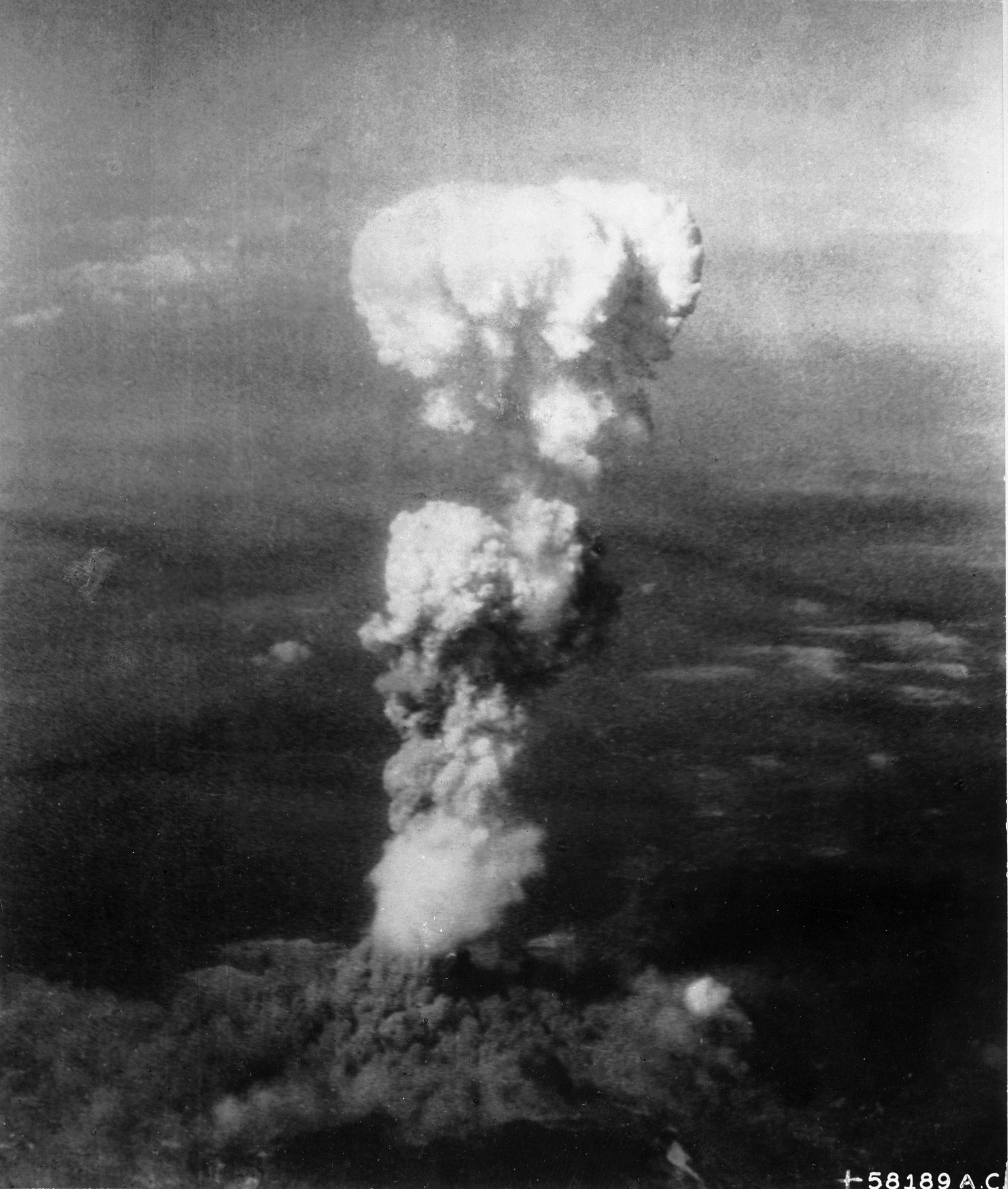
This must be the summer of rediscovering classic documentaries. The news has been considering the anniversary of the bombing of Hiroshima near the end of the Second World War. As you know, what makes it significance was this city was the first to be attacked by a nuclear weapon. The information is known, the bomber under Captain Paul Tibbets, piloting the bomber Enola Gay flew quietly over the city and dropped the bomb. The city became the first to be nuked.

What has been interesting is that there is discussion whether or not the bombing was necessary or was it simply done because the US had this weapon and it might have been more a warning to the Soviet Union rather then a means of bringing Japan to surrender. From what I read, there was never a thought Japan would surrender, or was on the verge of surrendering. The Japanese Government had rejected the Potsdam Declaration, which called for the Unconditional Surrender of Japan.

This has lead to the question, was the US right to begin the Nuclear Age against Japan. Certainly there had been warning about something horrible. Was the US moral in doing so? I thought about a comment I heard in the Documentary "War" by Gwynne Dyer. I did a search of YouTube and found the clip:


The comment by Sir Arthur "Bomber" Harris was is there anything moral about war? Now directly this had to do with the policy of Bomber Command to engage in attacking the cities of the enemy to not only destroy their war industry but to attack and to terrorize the civilian population. The documentary, in the first episode, considers the march towards total war. Mr. Dyer discusses how that at first war was fought by small armies for a couple of days during a year and really didn't effect the nation as a whole. It was only when nations became industrialized and could turn war into an exercise of industrialization and mass production that the march towards total war happened. Now, all of the nation was involved in war, not just the armies but the civilians who worked in the war industry.


I'm just showing these two clips, it would be worth everybody's time to watch the entire episode. Mr. Dyer makes note of the fact that the 20th century happened in 1915 when a Zeppelin crossed the English Channel and dropped a few bombs in London. Now all became the target. As well, all became a legitimate target.

What all this has to do with Hiroshima? Mr. Dyer talks about the need for the theorists of Air War to find a way to destroy the cities of the enemy that is cost effective. Up to Hiroshima, the classic way of attacking a city was to send hundreds of bombers with hundreds if not thousands of crews dropping tens of thousands of bombs. All this cost a lot of money. So there had to be a method that would do the same amount of destruction at only a portion of the cost. I'm not kidding, you can listen. I think this is why before the talk about Hiroshima takes place after a discussion of the bombing of Hamburg.
The result of the bombing was:
Operation Gomorrah caused at least 50,000 deaths, and left over a million German civilians homeless. Approximately 3,000 aircraft were deployed, 9,000 tons of bombs were dropped, and over 250,000 homes and houses were destroyed


Compares this to Hiroshima:
70,000–80,000 people, or some 30%[33] of the population of Hiroshima were killed immediately, and another 70,000 injured.[34] Over 90% of the doctors and 93% of the nurses in Hiroshima were killed or injured—most had been in the downtown area which received the greatest damage.


One plane, one crew, one bomb, yes it cost 2Billion Dollars to develop, but after that I suspect the cost comparison is quite reasonable. It's funny when it becomes a spreadsheet, doesn't it.

What we need to do is not consider who's at fault for Hiroshima, but to consider what we need to do as humans. I think this song says it all:


Too much of our history is already dedicated to war and conflict. How about working so we will never have to study war no more.

Thursday, August 05, 2010


Democracy vs Nomocracy


Much has been written after the news that Judge Vaughn R. Walker has ruled that Proposition 8 and the subsequent "California Marriage Protection Act" is unconstitutional. To remind you, it was on the November 2008 ballot and the initiative was passed by the people of California by 52% to 48%.
The Proposition stated:
Section I. Title

This measure shall be known and may be cited as the "California Marriage Protection Act."

Section 2. Article I. Section 7.5 is added to the California Constitution. to read:

Sec. 7.5. Only marriage between a man and a woman is valid or recognized in California

while the article from the CBC calls it a ban to same sex marriages, that's not quite the wording, it is more a protection of the traditional definition of marriage.

Going back to the ruling, the Judge declared that such a law is unconstitutional in that it violates the 14th amendment. The section, which is the first, is:
All persons born or naturalized in the United States, and subject to the jurisdiction thereof, are citizens of the United States and of the State wherein they reside. No State shall make or enforce any law which shall abridge the privileges or immunities of citizens of the United States; nor shall any State deprive any person of life, liberty, or property, without due process of law; nor deny to any person within its jurisdiction the equal protection of the laws.

By these words, the Judge declared the Law discriminated against people by making two different classifications of citizens.

What we have here and I can imagine what sides are saying, is the classic confrontation between Democracy and Nomocracy. The words are defined this way, 'the rule of the people' vs 'the rule of the Law'. This is the dynamic tension that exists within a democratic society.

I should say, that this blog is inspired by a quick dialogue I had on Facebook between Jo-Anne's niece Jennifer and myself. We need to consider a few things about democracy; it has been called the worst form of government, with the exception of the other ones. Then there is this thing about 'freedom of expression'. The vote on Proposition 8 was based upon the fact that California believes the citizens have a right to express their opinion on legislation which can be initiated by referendum. Now here's the problem, when you allow people to express themselves, they do just that. Democracy is messy and people when given the right to say or believe something they will do just that, and often it might not be the way the elite want them to think or say. I suspect that's why the vote was such a shock, this is progressive California, home of Hollywood with all those liberal types. After all, the elite and celebrities were all in favour. However, these weren't the only people who were allowed to vote. Everyone had the right to vote, including people who held to traditional viewpoints of marriage and family. Peoples who were conservative in their thinking in matters such as family and religion supported the view that marriage and family is based upon the traditional definition. I know that many twitters like to use the word 'bigot' and 'haters' or h8rs as the only ones who supported Proposition 8. Of course that's the traditional way to vilify and demonize the opposition. It's easier to call them 'haters' rather then calling them 'people who hold to a tradition view of marriage and family'. Plus it would use up almost all their 140 characters on twitter.

The 'power of the people' is the referendum. Then along comes Judge Walker and states the thinking is wrong, or rather, the outcome is wrong because it discriminates and you can't discriminate.

Of course, it could be argued Vox populi, vox dei, the voice of the people is the voice of God. I thought that until I discovered the entire text:
Nec audiendi qui solent dicere, Vox populi, vox Dei, quum tumultuositas vulgi semper insaniae proxima sit. which is translated as:
And those people should not be listening to those who keep saying the voice of the people is the voice of God, since the riotousness of the crowd is always very close to madness.. That's the rub, while we should support that people have the right to express themselves and it is good if the will of the majority holds sway; there is always the danger of the tyranny of the majority. The problem is that the majority usually like things the way they are, if there is no compelling reason to change, they will stick with the status quo. This is where the rule of law must come in. The one thing the majority can never do is overcome the Constitution. It is the document which expresses the fact that people have rights and these rights are possessed by all members of the society. It protects people from each other.

This is why there is a way to add rights and not take them away. All nations with a written constitution have an amending formula to the Constitution. Usually they are next to impossible, by the way, but there is nothing in the Constitution to take away rights. This is the brilliance of the Constitution because the writers knew there was always a danger that a demagogue could come along and convince to take rights away from a segment of society.

This is not to say the Law is perfect, I mentioned the danger of democracy, that if you let people express themselves, they will and it may have issues with the rights of the minority. Let me suggest the words of Charles Dickens:
If the law supposes that, then the law is a ass, a idiot! If that's the eye of the law, then the law is a bachelor. And the worst I wish the law is that his eye may be opened by experience.
.

The Law can have some clunkers, remember Dred Scott. The law upheld the notion, in the States, that a slave:
the Court ruled that slaves had no claim to freedom. They were property and not citizens, and could not bring suit in federal court. Because slaves were private property, the federal government could not revoke a white slave owner's right to own a slave based on where he lived, thus nullifying the essence of the Missouri Compromise
. So the Court decided that a slave was not a Person. The quote is from Wikipedia, by the way, look it up. It took a lot of people and a War to change the Law, but it was changed.

So you have the messiness of democracy and the clunks of the Law. But it is when both work together the genius of democracy is found. There are times when the Law stands up and declares the Truth and others when the People rise up against an unfair Law and demand a change. Both have happened and both will happen. The Law can drag the people kicking and screaming into the 21st Century, and the People can drag the Law into Freedom and Democracy.

Both must exist.

If you ask me which is worst, Democracy or the Law. I would say 'yes' and 'no' to both. True law cannot exist or gain legitimacy unless it comes from the people, the Demos, as you will and Democracy cannot exist or have expression unless protected by the Law.

They work together and must continue to do so, keeping watch over each other should the one stray and helping each other, keeping the balance so that true democracy can exist.

Monday, August 02, 2010


Who Owns the Sidewalks


There's a couple of sources for this blog. In a way, its been inspired by what I've seen and heard about the situation now facing pedestrians as they traverse from place to place. If you've been a pedestrian you know that things are dangerous out there. Try crossing a busy street even if you do have the light. In some ways it is far safer to jay walk because there's the element of surprise. Drivers view crosswalks much in the same way fishermen observe fishing ponds, filled with the targets of their desire. Am I saying that most drivers go out of their way to maim pedestrians, no of course not, they simply don't pay them the slightest bit of attention. I truly believe drivers, and I am one of them, view pedestrians the same way they view squirrels, if the squirrel gets across the road, that's good, if it doesn't, well, its road kill.

Issue number 2 of the most excellent Urban Interest Magazine, Spacing had on its cover, the title "Everyone is a Pedestrian". The article has this in its opening paragraph:
We’ve been walking upright for a few million years, but over the last century we’ve sat back and watched our species do everything it can to abandon this unique ability. Our culture minimizes travelling by foot in every possible way — cities are designed to accommodate cars, kids count down to their sixteenth birthdays so they can drive, and people look at us funny when we choose to walk home from work. Even our language takes a jab at walking: “pedestrian” is a synonym for something boring or common. But the very fact that walking is common is what makes it great. Spacing’s second issue focuses on the many joys and obstacles — and the politics — of walking in Toronto.


The joys of walking. Something that can be forgotten in our society. It's not just cars either, one of the quickest things to close and the slowest to open is the sidewalk. At one time, construction sites had to leave the sidewalk open, and they would build an enclosure to keep the pedestrian safe. Now it seems its simplier just to stick a huge wire fence and plaster the sign "Sidewalk Closed" all over the place. After all, who worries about people walking. I know someone will say its far safer and makes the construction company less worried about litigation. Right and I cross over in busy traffic, usually where there is no crosswalk because some knob decided to start building something. But I digress.

Going back to my title, sidewalks are for pedestrians. Lately I've noticed they are sharing the space with wheeled vehicles. Let's go through the list. The first thing I've noticed more of is bikes on sidewalks. I'm not talking about children either, but adults. Now I understand why people ride on the sidewalks, its a lot safer. For the reason mentioned above, the cyclist feels they are taking their life in their hands being on a road. With drivers more then indifferent to the point of openly hostile if you ride a bike, its simpler to stick to sidewalks.

My concern is this, if we and I'm an avid cyclist, stay on the sidewalks, they win. If drivers don't see us on the road, then they're not going to care a whit about us. By being on the road, which we have the right to be on, by the way, we force drivers to respect us. Most drivers will respect the cyclist, and if we become more in number they will have to do just that.

The other issue is the electric pedestrian scooter. This may be the greater threat. Jo-Anne was listening to a radio station out of Hamilton and it had to do with the topic of those scooters. To put it bluntly, they can be a threat. One newspaper had the headline "90 year old injured"

Maclean's also had a recent article entitled: "Beware of seniors driving scooters".

Another article declares they are becoming a hazard. Part of the article reads:
There are no driving tests, no insurance, no speed limits and no authority governing their use.

"I'm not a psychologist, but it seems when these people use their electric scooters they develop a sense of entitlement, as if they have the right of way on the sidewalk," Ducker said.

"I see it in a lot of [scooter operators], in their body language and their comments and their demeanour."

Police aren't about to stand behind lamp standards with radar guns clocking speeding scooters, Ducker said, but he suggests scooters should be licensed by the province and a doctor should first have to sign off on a person's cognitive and physical ability to operate a scooter.


I think we can all agree with the sense of entitlement. They look straight ahead as if you're nothing more then a discarded Tim Horton's Cup. Some of them also look like running you over would make their day. I once made the comment to a few friends that the future, instead of being the dystopic vision of a punk of emo-punks with piercings and tats being the major threat, it will be old people in scooters, terrorizing whole communities. As the pension money dries up, these individuals will form gangs of scooters running over those emo-punks and shaking them down for money. If you think my vision is incorrect, just watch this Seinfeld clip:


I know I can be accused of ageism and someone will remind me that in a couple of years that may be me. First of all, I hope not. I plan to keep using these legs as long as possible.

What I am saying is, there needs to be some sanity. Sidewalks are the pedestrians only place of security. They walk and observe life from sidewalks. They should be looking at patio restaurants and interesting stores, checking out the fresh produce at the local green grocer, not keeping an eye open for scared cyclists or scooter drivers with attitude.

So what can be done. The scooters are too slow for the road, plus the rider wouldn't pay the slightest attention. They are not licensed, they need no testing. Perhaps the first step is to make everyone take tests before they get one of those things. The Maclean's article tells of a scooter rodeo:
Now, thanks to Cox, Qualicum Beach has an annual scooter rodeo where seniors meet in a parking lot to practise backing up and handling skills on a pylon course amidst blasting country music and the aroma of grilled meat on the barbecue. Const. Masi takes the microphone to address the crowd of about 50 seniors; 14 will ride the course. “You are to yield to vehicles and bicycles,” he booms. “You can’t pull into traffic. Use the crosswalks. Wear bright clothing. Remember! You are a pedestrian!”


Part of the problem is, they are viewed as pedestrians by the law. I think there needs to be a new catagory. Or how about this, encourage communities to build bike and scooter lanes and trails. Give them opportunity to ride unmolested and protect the pedestrian.

Who owns the sidewalk? The Pedestrian, they just now need to fight some more for their rights.

Wednesday, July 28, 2010


Water: A Human Right


Today the United Nations General Assembly passed a draft resolution declaring access to clean water and proper sanitation a Human Right.

A group calling itself Article 31 has been pushing the adoption of access to clean water the 31st Article in the UN Declaration of Human Rights. They would write the article in this manner:
Everyone has the right to clean and accessible water, adequate for the health and well-being of the individual and family, and no one shall be deprived of such access or quality of water due to individual economic circumstance.


The reason for this is simple:
The text of the resolution expresses deep concern that an estimated 884 million people lack access to safe drinking water and a total of more than 2.6 billion people do not have access to basic sanitation. Studies also indicate about 1.5 million children under the age of five die each year and 443 million school days are lost because of water- and sanitation-related diseases.


Water is one of the basic necessities of life. Without water, life on this planet does not exist. We need water and we need clean, safe water. The resolution makes it clear that it is the right of all people to have access to this water.

The actual wording for some of the text is:
Declares the right to safe and clean drinking water and sanitation as
a human right that is essential for the full enjoyment of life and all human rights;
2. Calls upon States and international organizations to provide financial resources, capacity-building and technology transfer, through international assistance and cooperation, in particular to developing countries, in order to scale up efforts to provide safe, clean, accessible and affordable drinking water and sanitation for all;


It seems so straightforward. After all, we do all understand that when we are thirsty, water is the best way to sate the thirst. We also use water in cooking and cleaning. As pointed out, clean water is very healthy for us, contaminated water is responsible for the death of millions each year.

A lot of people are very happy with this and a few are not. The BBC carried an article about this resolution and mentions some of the disagreement a few nations have with it. One of the nations with a problem is Canada. An article in the National Post gives some of the concerns. Part of the concern has to do with Canada's sovereign right to control its own supply of clean water. We all know that Canada has a fair percentage of clean water and there has been pressure put on the government, every so often to share it with those in need, in particular the US. However, for the Americans, the water would not be for the people, it will be for the agribusiness, and to fill the pools of people living in Arizona. Yes, that might be a slight exaggeration. The Post goes at length to quote from Maude Barlow. She says, at the end of the article:
All countries, whether they’re water-rich or water-poor are going to have to start building plans to protect their water. Even if you live in a country with a lot of water, there are going to be water refugees really soon and there’s not going to be anywhere in the world where there isn’t a demand on the dwindling water supplies.


One might ask if she's being hypocritical, since she doesn't want to share our water with anyone, especially the US. I wonder if anyone will remind her of this fact. Still, its not delivery, it cleaning up and providing what is there.

Two realizations, one the planet got more people and water is a finite resource. It is the challenge of all people to make water clean and to use it properly. I mentioned the pool owners in Arizona, I could easily have said 'Ontario'. This is, of course, like the old 'eat your food because people in Africa are starving'. Having a pool is not going to affect those in Africa, for example. What is needed is research and creativity to make the water that is available fit for human existence. As well, hopefully this means, water won't be subject to the privatization practices of the World Bank and IMF. You might recall that a number of years ago pressure was put on many of the developing world to privatize things such as water in order to qualify for loans. Now, hopefully, this will be the right of governments to make water available to its people.

How now can we make this the reality. It is easy to dismiss it, like everything else that comes from the United Naions. But if we forget that bias for a moment, we see the call to all of humanity, to the citizens of the planet, to ensure all do have access to clean water.

Tuesday, July 27, 2010

Considering Canadian Leaders' Future


Early this month I blogged about Elizabeth May's political future. There was a groundswell, or at least some talk that she should go. Actually by the Constitution of the party, her term was only four years and she would have to step down by 2010. Well, its 2010 and she should, to maintain the integrity of the Constitution, step down and have a leaderhip race. She should enter and perhaps she might surprise all her opponents and critics by winning just such a thing. By the way, there is someone who is running for her job, it is Sylvie Lemieux and she has quite a dossier. I still think Elizabeth should step down, because of the reason stated, if she doesn't it might cause some long term repercussions for the Party that would bring about long term damage. I am not going to declare my support at this time, I'm still trying to fill out the eballot for the Party.

I will say this about Elizabeth, she is using the tools of social networking to get the message out, this is now going to be so important. As well, a number of candidates send out tweets to keep everybody in the loop.

She as well, does present the Green view on major issues of the day. She is doing her best to keep the party relevant and engaged.

As I thought about it, I pondered what is the political future of the leaders of the various parties in Canada. Especially those in the House of Commons, and since I haven't done a political blog in a while, I decided to think about it. Here then, are my thoughts about the future for our leaders.

Stephen Harper. Yeah you want to bell that cat? I think he's quite safe in his position, being Prime Minister tends to give a person a safety net. Honestly, can you visualize what would happen to the poor shmuck who suggests Mr. Harper steps down? I think the last thing he or she will see is Harper reaching into his or her chest to pull out their still beating heart, ala Indiana Jones and the Temple of Doom. He's good. Besides this isn't Great Britain where the backbenchers can always revolt to get rid of a leader they don't like.

Michael Ignatieff. You ever to a cemetery and read some of the headstones. Its fascinating. You've perhaps come across the tombstones that have the person's name, date of birth but the date of death, aka their departure date is blank. That's Mr.Ignatieff. It's not so much a question of if, but when. When will his tenure as leader of the Liberal Party end? Before, after or during the next federal election? I think he's on the bus trip across Canada because a moving target is harder to hit.

Gilles Duceppe: let's be honest, the Bloc Québécois has morphed from a separatist party, to a nationalist party to a "let's keep going so we can qualify for that fully indexed MP pension" party. Yes they represent the aspirations and complaints of Quebec. They make all the right noises so that the separatists keeping voting for the BQ. Yes you have to keep those 10 guys and gals wearing the Quebec Nordiques jerseys happy. M. Duceppe facing almost no opposition from anyone in his party. He's good to go as long as he wants.

Jack Layton: He may be the enigma of Canadian Politics. Of all the party leaders, he's the one with the best numbers. In one poll I read, he was ahead of all of them, including the PM. He's hard working, he's on Twitter. In fact he post photographs to TwitPic. He's got some interesting posts as well. He's popular, the problem he faces is, the party isn't riding on his coattails. The NDP are still hanging in the 15-20% range, rarely more then that, rarely less then that. So whatever halo effect he may have, isn't happening for the party. Even in Progressive Toronto, there's just him and his wife as MP's. Lately he's been battling some health issues. Jack we're praying for you. Doesn't seem to face any opposition in the Party, even though he may come up with some bonehead ideas like a coalition with the Liberals. Seriously Jack, you want to unite with that dead weight? Steve Janke had an interesting editorial, in which he calls the Liberal Party: "Dead Party Walking".

I think Mr. Layton, baring health issues will have a successful term as leader of the NDP. Although I have to think that if the party remains stagnant in the range, there may be a suggestion for him to voluntarily step down.

Monday, July 26, 2010


Re-Discovering "The Ascent of Man"


It was one of those acts of kismet that can only happen on the Internet. I'm not sure how it all started, I believe it was watching some documentaries through Google Video, yes it still exists, when I cam across a documentary I haven't seen in, shall we say, decades. The Ascent of Man came out in the golden age of documentaries, when thinkers were able to take complex concepts and explain, not in simplistic terms, but rather to bring us to think and begin to see how it all comes together.

As I watched some of the episodes, of which there are 13, I was reminded of being absolutely riveted by the words of Dr. Jacob Bronowski. If you watch the opening, it becomes obvious, this is a rather dated opening:


After all, what screams 'the 70's' like the opening, with the music and the lettering. Also the show demonstrates signs that it was truly shot on 16mm film. However, that is not what makes this so fascinating, it was how Dr. Bronowski was able to present the ascent of humanity, it began with his opening words:
Man is a singular creature. He has a set of gifts which make him unique among the animals: so that, unlike them, he is not a figure in the landscape—he is a shaper of the landscape.


He witnesses both the greatness of humanity, the fact we as a species does shape the landscape, and yet in the shaper, comes the beauty and, sadly, at times, its ugliness. He can take ideas such as periodic table and turns to the fact it affects cubism:


He talks in the first episode, about evolution, not in the way we know or think about it, but the cultural evolution, that which takes our questioning, our emotions, our reason and makes us grow. It truly is a marvelous thought when you think about it.

Was this truly a time when intellectual project of the mind was not stuck into a dogmatic and political agenda. Today, for Dr. Bronowski just to breathe the word 'evolution', would cause people to demand to either burn Dr. Bronowski and the film to the fire, or make him the cause celebre of their agenda.

What Dr. Bronowski does, it not give a chronological study, but the great themes, that may take decades or centuries to come to conclusion, but that does not matter. He calls the episodes essays as journeys through intellectual history, of the high points of human history, or as he quotes Yates, monuments of unaging intellect.

Some might say that has been the problem of humanity, we become impressed with our monuments, but again, is that not human striving? Isn't this what brings about the change, the desire, not to make monuments but to understand. We are a questioning bunch and that also makes us dangerous. The greatest danger and the greatest act of intelligence is the one word 'why'? With it revolutions happen and atoms are understood and split.

Should a person get all tied into knots because Dr. Bronowski supports the views of Charles Darwin? After all, Darwin is the enemy of Christianity, as some would believe.

However, I wonder if there is a such a great divide? I know that many take the view, for or against, and make it political, I already used the word 'dogma'. I think of the words of David:
When I consider your heavens,
the work of your fingers,
the moon and the stars,
which you have set in place,

4 what is man that you are mindful of him,
the son of man that you care for him?

5 You made him a little lower than the heavenly beings [c]
and crowned him with glory and honor.

6 You made him ruler over the works of your hands;
you put everything under his feet:


The spark of creativity comes from the creation of humanity. In the end, that is what matters. In the creation it matters not how it all happens, rather that we bear the spark of divinity and inquisitiveness.

It is interesting to listen to Dr. Bronowski describe a baby as a mosaic of animal and angel. He takes the moment a baby stands up and makes the first steps as a dramatic moment.

Now the series is not one that looks at the achievement of humanity as only good and great, he considers some of the dark moments of humanity:
It's said that science will dehumanize people and turn them into numbers. That's false, tragically false. Look for yourself. This is the concentration camp and crematorium at Auschwitz. This is where people were turned into numbers. Into this pond were flushed the ashes of some four million people. And that was not done by gas. It was done by arrogance, it was done by dogma, it was done by ignorance. When people believe that they have absolute knowledge, with no test in reality, this is how they behave. This is what men do when they aspire to the knowledge of gods.

Science is a very human form of knowledge. We are always at the brink of the known; we always feel forward for what is to be hoped. Every judgment in science stands on the edge of error and is personal. Science is a tribute to what we can know although we are fallible. In the end, the words were said by Oliver Cromwell: "I beseech you in the bowels of Christ: Think it possible you may be mistaken."


He reminds all of us, we may make mistakes.

I plan to watch the series and enjoy all of them.

Sunday, July 18, 2010


Steve Jobs, AntennaGate and Fanboys


Full disclosure time: I have been a fan of the Apple iPod line of products since the iPod Mini. After a time, I received a Nano and then recently a Touch. I do like these products and enjoy the hours of entertainment each has brought. I have also enjoyed the weather of media offered through the Apple iTunes Store.

Now for full disclosure 2: I know nothing about antennas, radio waves and how it all comes together for a cellular phone. My phone is the Motorola MotoKrzr, which is the means by which I text, talk and take the occasional photograph. Alright, more then the occasional photograph.

I didn't watch the press conference, but I have followed it through news reports and blogs. What I have noticed there are two distinct themes going through it. The first theme was, there is a problem and Apple plans a work-around until its fixed. The work-around includes a free case and the opportunity to return the phone should the owner simply not want it anymore. Both are laudable and should have dealt with the immediate problem. Apple had to move on this, it was be reported in the media and it was now becoming the butt of jokes:


He goes before the media and gives an apology and a promise to do better. That is good, however, he had to go weasel on us, and this is the problem.

Let me give a few points on the Job's weasel imitation:

1) the iPhone parody song:


A parody pokes fun and I'm sure many would think so, but a careful listen to the lyrics gives a bit of a different spin. The message if you don't like it, don't buy it or return it. In other words, the message from Apple is, 'we don't really care about your problems or complaints. You don't like it, get lost'. Not bad for a company that says it wants its customers happy. The second is the whole 'death grip' comment. Consider this, the 'grip' that caused the problem is not a death grip, but the standard and natural way people hold their cellphones. It's how its held and although Steve Jobs said it should be held differently, that hold is the standard, there is nothing wrong with the way its hold, the problem is the location of the antenna.

The third problem and this is vintage weasel is that Steve said Apple is not unique with this problem. In fact most smartphones have this problem. Jobs said:
What we have learned is smartphones have weak spots, not unique to iPhone 4. All smartphones have weak spots and you will drop calls. AppleCare data shows that 0.55 percent of all iPhone 4 users have called about antenna or reception. If you read all these articles, half our customers have called and are angry. One half of one percent — 0.55 percent! Historically, this is not a large number. Doesn’t jive with what you read about this problem.


Of course this got under the skin of some smartphone manufacturers, who had a slight disagreement with Mr. Jobs assessment:
However, RIM's co-chief executives Mike Lazaridis and Jim Balsille said over the weekend: "Apple's attempt to draw RIM into Apple's self-made debacle is unacceptable. Apple's claims about RIM products appear to be deliberate attempts to distort the public's understanding of an antenna design issue and to deflect attention from Apple's difficult situation."

Mr Jobs has apologised to disgruntled Apple customers and promised to give away a free case with every iPhone 4 sold until September.

The RIM executives added: "One thing is for certain, RIM's customers don't need to use a case for their BlackBerry to maintain proper connectivity."

Nokia has also launched a strident defence of its phones. The company said: "We prioritise antenna performance over physical design if they are ever in conflict."


Now Apple wants to point a finger and say, 'look, everyone else has the same problem, why are you picking on us...' I like what one person commented on the GigaOm website:


Wow, so to apple, who made this video before the press conference, it’s just a big joke to them that customers are having a problem? So, they say, we made lots of other stuff and nobody complained so we can never be accused of making a mistake, … Ever.

I can see BP adopting this tactic. Hey, what’s one little oil spill? We drilled thousands of wells and so one of them leaked. Don’t swim in the oil if you don’t like it. Only, like 1% of our customers world-wide are affected by that well.


BP could adopt this strategy, and the US government would be including a few more zeros on the fines to be levied.

Then what really got to me was the reaction of the fanboy element. This is always Steve Jobs secret weapon, his cadre of fanatics who will go out of their way to demean and discredit any and all critics of Apple. PCWorld had an article entitled:
"Apple must kill the iPhone 4", and it drew the response of the fanboys:
Not surprising considering the source. The most one sided subjective biased opinion on the matter. And of course it's from "PC WORLD" why would they want it to be objective? The don't.

How's this, I think PC World should kill PC WORLD, the sooner the better!!


If Steve Jobs had said to the crowd: "go and burn down the PC World offices", it would have been destroyed. In fact had Jobs told the assembled to hunt down and destroy the .01% who criticized the iPhone, there would have been a lot of dead bodies out there.

What also got to me was a comment Robert Scoble left on the website Cinch. He had a comment he entitled; "Arrogance or Artistry at Apple". His comments included things like "why is the media piling on at Apple?". Probably because the media has been piled on by the fanboy when they have dared made a negative or questioning comment towards Apple and Steve Jobs. He kept saying its the best phone ever and that Steve Jobs is an artist and the iPhone is a masterpiece. Sure, stick it on your walls, because you may have problems with it as a phone.

With all this, would I purchase an iPhone 4? Hard to say, I still have a little over one year left on my contract and I'm not sure I'm going to change carriers when its all over, or I could go back to Virgin.